Thursday, 16 October 2014

"Art does not need us, and it never did"; exploring Malevich's work through his exhibition at the Tate Modern.

Kazimir Malevich was the creator of Suprematism, mentor to El Lissitzky and one of the first truly abstract painters. His work was said to “negate everything good and pure” and was so groundbreaking that his paintings were confiscated under the Stalinist regime and did not re-appear for many years. I have never been a huge fan of abstract art of this kind but tried to keep an open mind while walking around the exhibition. However, I found that when I looked at Malevich’s suprematist work I struggled to see it as anything other than varying compositions of lines and shapes.  “Modern art” in its abstract form can be seen in so many places and is so accessible that you can buy a phone case with Malevich’s work printed on the back and have it delivered to your house within 2-5 days. It’s almost impossible for somebody of my generation to see things through the eyes of someone born in 1879; we are worlds apart and although I can understand the significance of what he did in his time, the majority of his work does not speak to me in the way that some others do. This is what I told my lecturer Phillip Long when he asked me why I seemed frustrated and his reply was that I should simply find one painting that I could happily hang on my bedroom wall, and then focus on that. 
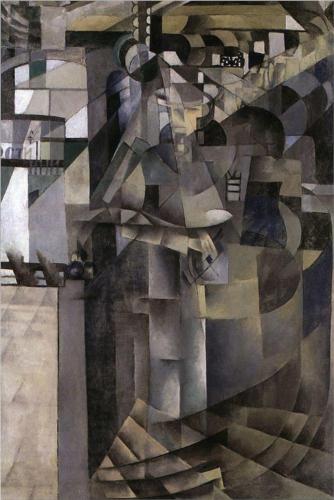

I found myself drawn mostly towards his work referencing cubism; specifically one painting titled In The Grand Hotel (1913).  I noticed that every time I glanced at the painting, I saw it in a different way; the fragmented shadowing almost makes the figure of a man but if you look at it for too long he begins to disappear into abstract shapes and lines.  I think perhaps what I like about this work is that it allows me to use my own perspective when viewing it, it allows me to piece together what I see and form something in my mind that will be entirely different to the way anybody else sees it.  Malevich said “the artist can be a creator only when the forms in his picture have nothing in common with nature” and this is what his suprematist works have achieved. They are detached from nature and emotion, entirely logical and perfectly balanced. I always try to avoid saying I dislike the work of such an influential artist because I worry it will make me seem ignorant and unappreciative of what they did to inspire the progression of art. I understand that it is thanks to people like Kazimir Malevich who were brave enough to break through people’s preconditions of what art should be that I am allowed to explore art in all of the ways I am now. But with that said, I walked through the many rooms of this exhibition and nothing I saw really made me feel anything. Nothing gave me the feeling of fire in my stomach inspiring me to create something new and at the end of the day that is what I look for in art and that is why I love it.


This exhibition has given me a more developed understanding of abstract art and Suprematism but I think the most valuable thing I witnessed was Malevich’s personal progression through different styles and movements. It was fascinating to see how the pages from his sketchbooks transformed into paintings and to see him experiment with varying styles before finding one that suited what he wanted to express. I have always worried about finding my own unique style and I think Malevich demonstrates that an artist can work in many different ways and still find their place in the art world - it just takes time.

Monday, 10 February 2014

Sheikhs and Llamas (discussing Wael Shawky's "Al Araba Al Madfuna")

Wael Shawky's exhibition titled "Al Araba Al Madfuna" is a showcase of several of his works including The Cabaret Crusades series as well as Al Araba Al Madfuna and Al Araba Al Madfuna II. Shawky is extremely focused on the idea of storytelling, he says he is less interested in history and more in how we as humans interpret and re-tell that history. The Cabaret Crusades are Shawky's adaptations of Amin Maalouf's book The Crusades Through Arab Eyes, which is a narrative retelling that exposes the Arab side of the Crusades. In the first Cabaret Crusades film titled The Horror Show File (2010), Shawky incorporates the use of 200 year old wooden marionettes from the Lupi collection in Italy to re-tell events up to the fall of Jerusalem in 1099.

In the second, titled The Path to Cairo (2012), Shawky this time created 110 ceramic marionettes in his own style, with help from puppeteers and ceramists from Italy and France. This time we witness a re-telling of events that happened between the first and second crusades. He says that "when you work with marionettes, you do not depend on acting skills. These are not the priority. The priority is the value of the event." He also enlisted the help of Serbian mathematician and geographer Matrakci Nasu, to help create the sceneography. Shawky says he was trying to create something like a pop-up book, to create a mix between the 3D of the marionettes and the 2D of the background. He says this is because in Muslim manuscripts, the paintings were "very flat" with "no perspective" and authenticity is extremely important to him. In this pursuit of authenticity, Shawky also travelled to Bahrain in search of people to sing a specific type of music called Fidjeri, which was created by the pearl fishers of the Gulf Region over 800 years ago. The Path to Cairo also features the voice of Ali Hammadi, a very famous "Radood", which is a special reciter that sings religious stories.

The first Al Araba Al Madfuna and Al Araba Al Madfuna II are visually very different to the Cabaret Crusades series, but is extremely similar in intentions. Shawky uses children dressed as adults, dubbed with adult voices to re-tell Mohamed Mustagab's parables, mixed with his own experiences to create a multi-layered story. The first, calls upon Mustagab's tale of a tribe who continually changed it's entire state  of being to comply with the leader's final words, always along the lines of "I advice you to get a ___". They do so with camels, mules and pigs before the story ends. Shawky couples this with his own experience in the village of Al Araba Al Madfuna, where he witnessed so called "Sheikhs" who are something like spiritual shamans who can sense where the tombs of the old Egyptians are buried. Al Araba Al Madfuna, the village, is on the same hill under which a temple for the ancient Egyptian God Osiris was discovered at the beginning of the 20th Century. In interviews Shawky talks about how if a Sheikh senses something, the family begins digging at once. He says that "sometimes a whole generation dies and the next one has the same dream and continues, so they can definitely dig for twenty years in the same spot." The message Shawky is trying to convey through these multi-layered stories, is that culture and tradition is important but that there is always two sides to a story. You must not become so enthralled with your own culture's ways that you cannot see the ways of others. He does this by having wars narrated by marionettes and wise old voices coming from children's bodies to tell us magical fables. Shawky says in interviews about working with children that "theirs is a more neutral society, they don't have cliches or preconceptions for history. They don't know how to they're supposed to act." In this sense, they are similar to the marionettes; shawky can talk to us through them without interference. He is giving us a raw, authentic storytelling of the crusades through Arab eyes.

Sunday, 9 February 2014

Eat Your Mind (discussing the Chapman Brother's "Come and See")

The Chapman brother's latest exhibition at the Serpentine Gallery, titled "Come and See" is a bombardment of shock and horror. The first thing you meet with are the infamous "hellscapes"; tiny massacres in a box that allow you a gods-eye view of tiny ant sized humans in various states of disembodiment and torture. I found it easy to get lost in the sheer scale and detail of these works, hundreds upon hundreds of minuscule models all piled up, sewn together and fighting each other.

Among the dark Nazi skeletons and mutant four-armed head creatures, are the unlikely positioned McDonald's characters. During an interview with the Standard, November 2013, Dinos Chapman talks about the importance of humour in their work; he says that it shouldn't be thought of as a lesser response and that it can be used to make the most horrific of situations no longer horrific. In the same interview Jake Chapman talks about addressing the "general depoliticization" of our culture; he says that "when you realize the lack of power that anyone has in a democratic country, you realize we're fucked. All we can do is instigate certain disruptions on a myopically tiny level." In a sense it is commenting on the power we have, or lack of it - mannequin Ku Klux Klansmen with rainbow coloured socks stand by our sides enjoying the same art as us, suggesting we're no better than they are. On a smaller scale it comments on morality; will you sit by and watch as your fellow humans are mistreated or will you have the courage to stand up and change what's happening? The Chapman Brothers push your senses to the limit, leaving you outraged but unable to look away.

There is a quote written around the wall that reads "get rid of meaning, your mind is a nightmare that has been eating you; now eat your mind." The quote, which comes from Kathy Acker's Empire of The Senseless suggests the Chapman Brother's want us to remove meaning, to see what is really in front of us. The exhibition title "Come and see" is supposedly named after Elem Klimov's 1985 soviet war drama/psychological thriller film of the same name. It is about and occurs during the Nazi German occupation of the Byelorussian SSR and in turn got it's name from The Book of Revelation in which "come and see" is said repeatedly as an invitation to look upon the destruction caused by the four horsemen of the apocalypse. Jake and Dinos Chapman are inviting us to see horror and ask ourselves what part we play in it.