Kazimir Malevich was the creator of Suprematism,
mentor to El Lissitzky and one of the first truly abstract painters. His work
was said to “negate everything good and pure” and was so groundbreaking that
his paintings were confiscated under the Stalinist regime and did not re-appear
for many years. I have never been a huge fan of abstract art of this kind but
tried to keep an open mind while walking around the exhibition. However, I found
that when I looked at Malevich’s suprematist work I struggled to see it as
anything other than varying compositions of lines and shapes. “Modern art” in its abstract form can be seen
in so many places and is so accessible that you can buy a phone case with
Malevich’s work printed on the back and have it delivered to your house within
2-5 days. It’s almost impossible for somebody of my generation to see things
through the eyes of someone born in 1879; we are worlds apart and although I
can understand the significance of what he did in his time, the majority of his
work does not speak to me in the way that some others do. This is what I told
my lecturer Phillip Long when he asked me why I seemed frustrated and his reply
was that I should simply find one painting that I could happily hang on my
bedroom wall, and then focus on that.
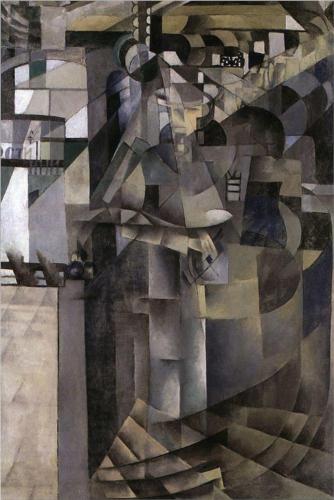 I found myself drawn mostly towards his
work referencing cubism; specifically one painting titled In The Grand Hotel (1913). I
noticed that every time I glanced at the painting, I saw it in a different way;
the fragmented shadowing almost makes the figure of a man but if you look at it
for too long he begins to disappear into abstract shapes and lines. I think perhaps what I like about this work
is that it allows me to use my own perspective when viewing it, it allows me to
piece together what I see and form something in my mind that will be entirely
different to the way anybody else sees it.
Malevich said “the artist can be a creator only when the forms in his picture
have nothing in common with nature” and this is what
his suprematist works have achieved. They are detached from nature and emotion,
entirely logical and perfectly balanced. I always try to avoid saying I dislike
the work of such an influential artist because I worry it will make me seem
ignorant and unappreciative of what they did to inspire the progression of art.
I understand that it is thanks to people like Kazimir Malevich who were brave
enough to break through people’s preconditions of what art should be that I am
allowed to explore art in all of the ways I am now. But with that said, I
walked through the many rooms of this exhibition and nothing I saw really made
me feel anything. Nothing gave me the feeling of fire in my stomach inspiring
me to create something new and at the end of the day that is what I look for in
art and that is why I love it.
I found myself drawn mostly towards his
work referencing cubism; specifically one painting titled In The Grand Hotel (1913). I
noticed that every time I glanced at the painting, I saw it in a different way;
the fragmented shadowing almost makes the figure of a man but if you look at it
for too long he begins to disappear into abstract shapes and lines. I think perhaps what I like about this work
is that it allows me to use my own perspective when viewing it, it allows me to
piece together what I see and form something in my mind that will be entirely
different to the way anybody else sees it.
Malevich said “the artist can be a creator only when the forms in his picture
have nothing in common with nature” and this is what
his suprematist works have achieved. They are detached from nature and emotion,
entirely logical and perfectly balanced. I always try to avoid saying I dislike
the work of such an influential artist because I worry it will make me seem
ignorant and unappreciative of what they did to inspire the progression of art.
I understand that it is thanks to people like Kazimir Malevich who were brave
enough to break through people’s preconditions of what art should be that I am
allowed to explore art in all of the ways I am now. But with that said, I
walked through the many rooms of this exhibition and nothing I saw really made
me feel anything. Nothing gave me the feeling of fire in my stomach inspiring
me to create something new and at the end of the day that is what I look for in
art and that is why I love it.
This exhibition has given me a more
developed understanding of abstract art and Suprematism but I think the most valuable
thing I witnessed was Malevich’s personal progression through different styles
and movements. It was fascinating to see how the pages from his sketchbooks
transformed into paintings and to see him experiment with varying styles before
finding one that suited what he wanted to express. I have always worried about
finding my own unique style and I think Malevich demonstrates that an artist
can work in many different ways and still find their place in the art world - it
just takes time.

No comments:
Post a Comment